Whew! It's been a ridiculously hectic and stressful several weeks (but I am elated to report that I have recently reached the end of the process that was causing so much stress, hence why I have the time to write this now). This past Saturday, I decided I needed a break, so I went out to visit the Arcata Bottoms, an area of low-lying pastures and fields bordering the bay near my house. I drove slowly along roads behind farms, and I wandered into the marshy fields in a neighboring wildlife area, and it was quiet, full of creatures, and just wonderful.
I drive by this area on the way to work every day, and I'm always astonished by the number of raptors I regularly see here -- perched on fence posts and power lines -- as I speed past. Driving slowly and walking in the fields on Saturday was much more fun, and there were birds of prey everywhere I looked. Northern Harriers coursed low over the fields and picked up furry morsels:
Northern Harriers have such interesting faces, and I'm always glad to meet these sleek hunters:
White-tailed Kites are still an amazingly exotic bird for me, but they're downright common in these fields right now. I saw at least four individuals during my visit, sometimes hovering or hunting but mostly perched on trees:
What an awesome bird:
Fence posts made for especially popular lookout points. White-tailed Kite:
Northern Harrier:
More White-tailed Kites:
Ah! Owl!!
I knew that Short-eared Owls hang out in these fields in the winter, and I was hoping to catch a glimpse of one, but having a Short-eared Owl fly out right in the middle of the afternoon and land ahead of my car -- then proceed to hunt in the field next to the road -- was basically astonishing. My first Short-eared Owl! Oh my goodness.
Owls are certainly amazing, and as far as I'm concerned, days with owls in them are some of the best days. I love this creature's rounded wings, fuzzy feet, and black-eyeliner eyes:
Oh, you wonderful creature:
So that was amazing. Other highlights from the visit include a dainty Savannah Sparrow, a bird I haven't seen since my time on the Connecticut shore:
And around 1500 Cackling Geese foraging in the pastures. Here's a portion of the expansive flock:
This was my first time seeing Cackling Geese fairly close up, and they really do strike me as shrunken Canada Geese. Don't your necks stretch any longer, birds?
The geese made for some striking patterns, especially in such big numbers:
And once again, Northern California continues to amaze me. Even the most normal-seeming places -- fields, pastures -- have awesome wildlife, including lots of creatures I've never seen before (and am not likely to see again any time soon once I leave). The stress-inducing process I mentioned at the beginning of this post was a job hunt, and the end of that process means that I will be relocating yet again over the summer, back to the other side of the country. The eventual (permanent? is that even possible?) location is a very exciting one (for me), but I'll leave those details for another time. For now, I plan to take advantage of my remaining months in Northern California to explore the area as much as possible. There's still so much to see, and I'm so happy to have my outdoors time back!
I couldn't find the Piping Plover pair that's been hanging out at Silver Sands State Park when I visited yesterday morning. They may have decided to nest somewhere else, or perhaps they were just particularly well hidden.... I'll continue to keep an eye out for these little birds on future visits. Even without nesting plovers, however -- and despite the occasional drizzle -- there were tons of cool things to see. The park was positively overflowing with activity!
One of the first creatures I saw when I first arrived was also one of the most exciting, because I've only seen them once before, and never before a male in his super strange breeding plumage. Look, a Bobolink!
Make that a whole bush full of male Bobolinks, with their black bellies and yellow caps:
When these birds weren't perched in bushes and singing their weird metallic bubbling songs, they were foraging in the grass. The dandelion heads were apparently particularly interesting:
Bobolinks are pretty uncommon in this part of Connecticut, so I consider this a lucky encounter indeed!
In the marsh, two Willets (large-ish shorebirds with distinctive black and white wings) were preening:
This happy Willet made some cool ripples as it bathed:
Also wandering through the marsh were several Semipalmated Plovers. These birds are small like Piping Plovers but they have brown backs and wings like Killdeer; and, like all plovers, they're adorable:
I've commented many times in this blog on the secretiveness of Clapper Rails, who I often hear calling in these marshes but who typically remain hidden among the grass. The more I visit Silver Sands State Park, however, the more these birds defy my expectations. I've seen them several times now in July and August, after their chicks have hatched. A couple of weeks ago, I actually saw one calling from a slight rise in the marsh landscape. And then yesterday, who should come walking out onto the open mudflats, bold as can be, but a Clapper Rail:
The bird spotted me, but it only ambled (rather than raced) toward cover in the grass, walking right by me in the process. In fact, it seemed to strut and pose as it passed.... Well, sure Mr./Mrs. Rail, I'll gladly take your picture. What a gorgeous bird!
Rail tail!
Clapper Rails have such unusual body shapes. I'm struck by how skinny/compressed this bird looks from behind. It's thin as a... haaaang on.
I've now looked up the phrase "thin as a rail" to try to find out where it comes from. Several online sources say that no, "rail" in this phrase doesn't refer to a man-made bar or post (as I've always assumed), but rather to the bird, which is quite thin and thus better able to move through marsh grass. But then a few other sources say that in fact, no, you had it right the first time: It's not the bird, as some people have recently suggested, but rather the man-made object! So basically, if I say that the Clapper Rail is "thin as a rail," I still have no idea whether I'm being clever, or redundant, or silly. Ah well. Regardless, I'll think of this bird now whenever I hear that phrase.
A second Clapper Rail was even camped out nearby, again in plain view, and the two birds cackled at each other when the first one got close:
Are these birds not actually as secretive as I thought? I'm not complaining! Be as bold as you like, Clapper Rails.
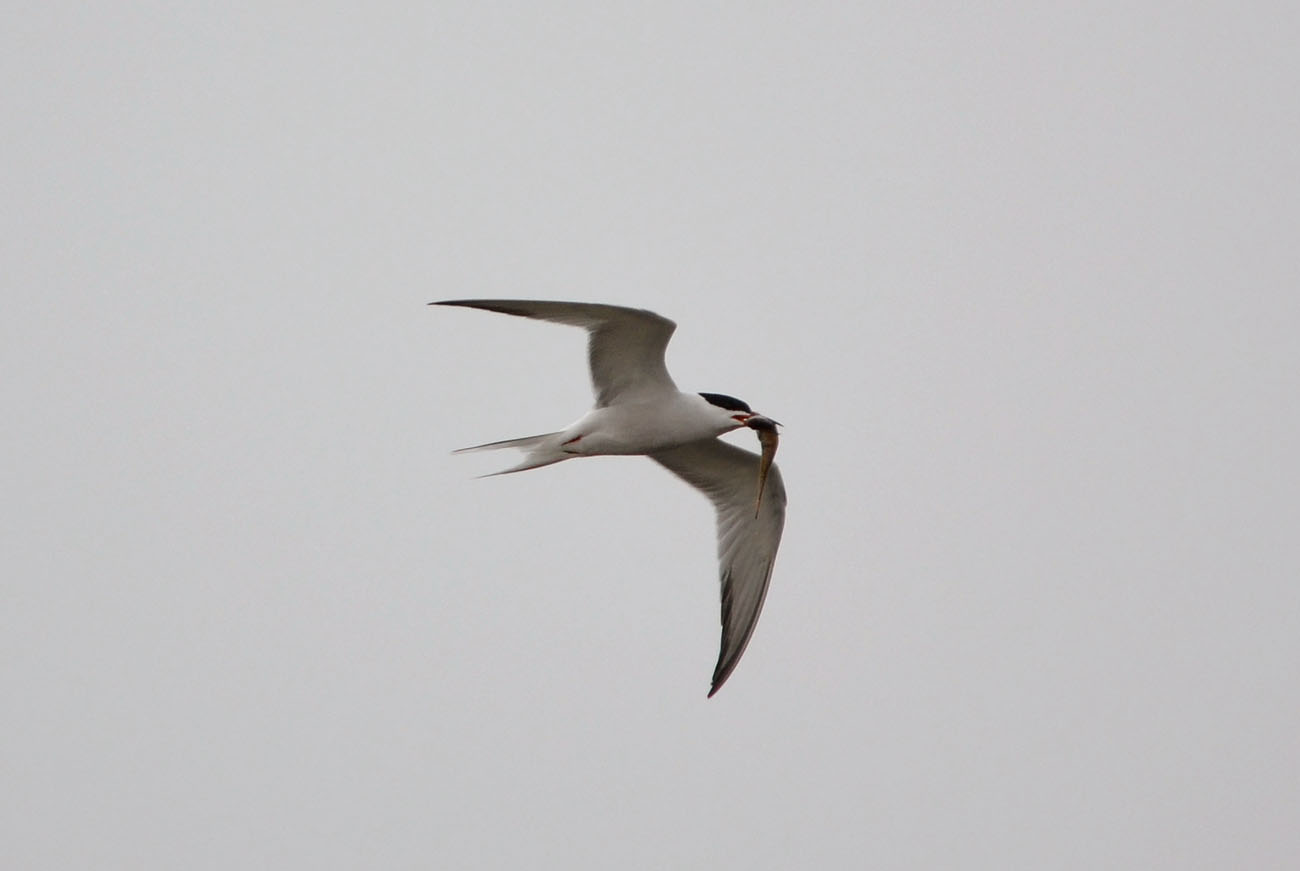
On the beach, a trio of Common Terns were chasing each other across the sky, one of the terns carrying a fish (perhaps for courtship purposes):
There have been so many male Red-winged Blackbirds in this park in recent weeks, it's nice to see the females showing up as well:
Yellow Warblers nest in this park's fields, and a few males were fluttering around and calling during my visit:
These bright little birds make quite a sight, even from a distance:
And this is why people (in North America) don't like European Starlings. I checked on the nesting cavity that the Northern Flickers worked so hard to excavate over the past few weeks, only to find a starling sticking its head out of the hole:
I know it's not the starlings' fault that they're on this continent, and it takes a feisty bird to chase off a powerful Northern Flicker, but... starlings have so many nesting options. Couldn't they have left this cavity to the flickers? Yes, you're very fancy with your spiky throat and triangle wings, but I'm not impressed. Eh, starlings:
In more overall positive nesting happenings, I was happy to see this cool structure hanging from a tree branch:
A Baltimore Oriole nest! The male oriole was singing nearby and keeping another male from his territory, while the female oriole was busy using her excellent weaving skills:
This is such an amazing structure, and I'm curious about the material she's using. Some sort of plant fiber perhaps? Here's a video of the female at work:
Here are a couple more happy sights to close out my visit. This patch of Lance-leaved Violets (Viola lanceolata) made a small field of stars shooting up from the muddy ground:
And I loved seeing this Savannah Sparrow perched near the ground, its yellow eyeshadow so perfectly matching the blooming dandelions:
There are so many amazing things to see right now!
Whew! There has been a lot of concentrated work going on around here in the past couple of weeks. But then this morning, as my reward for meeting a big deadline yesterday, I finally got to go outside again. :) Yaaaay, freedom from my computer screen!
For my mini-vacation, I chose to visit the shore. I knew it was going to be cold out there, but what I wasn't expecting was the freezing wind that hit me almost as soon as I got out of my car. "Biting" is an extremely apt descriptor here. (In hindsight, this would have been an excellent time for me to be wearing that wool balaclava I got for Christmas.... Oops!) As it turned out, I was only able to last about 30 minutes outside at a time, so I adopted a strategy that balanced outdoors-time and survival pretty nicely: I hopped back and forth between two beaches a few minutes drive from each other, and warmed up in the car on the way. Thank goodness for my car's heater!
I started off the morning at Silver Sands State Park, where heavy clouds and morning light made for some very dramatic skies over the Long Island Sound:
Charles Island looked downright stark, out alone in the water, and with that weird orange light beaming out from it:
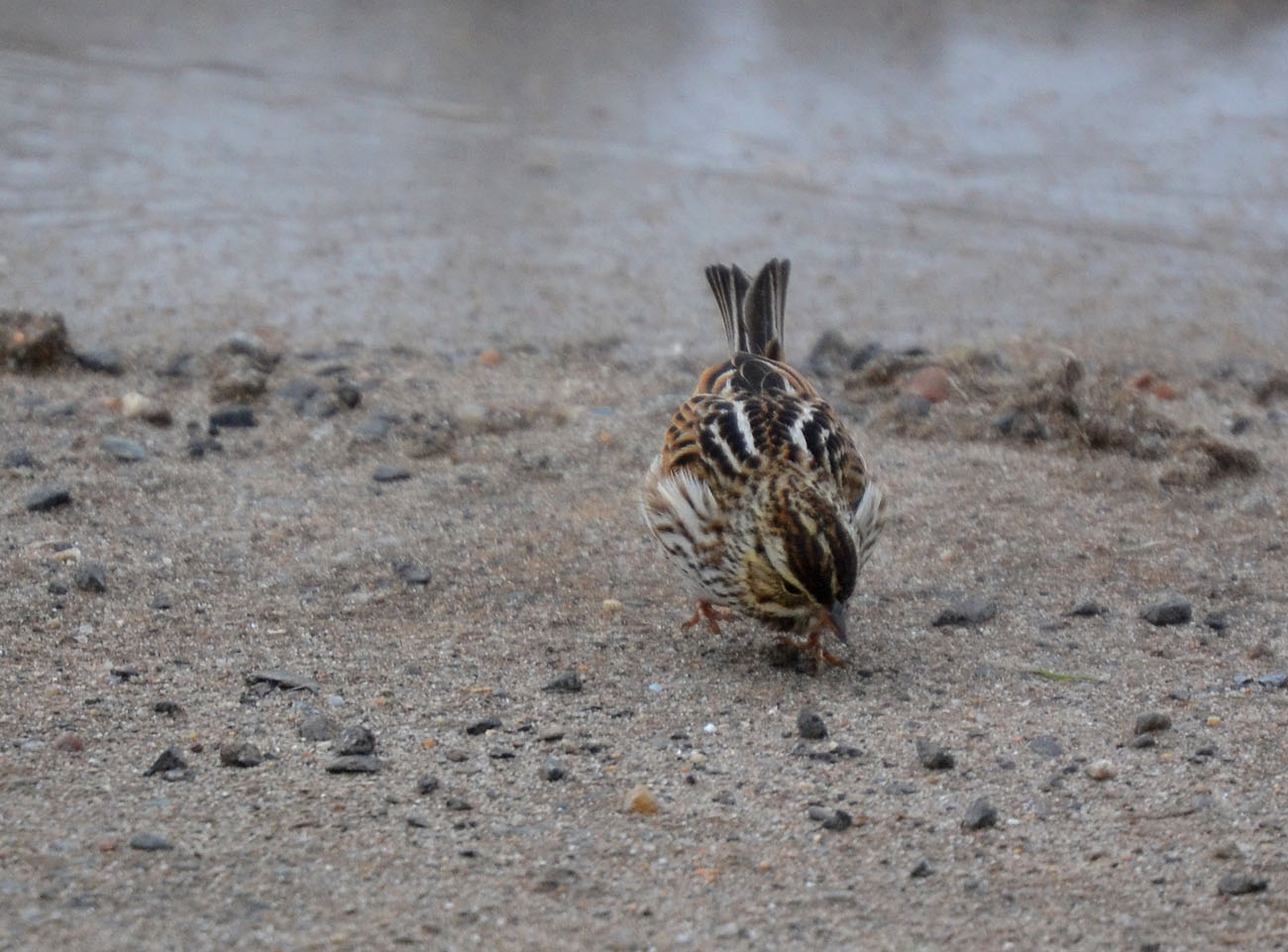
Near the the entrance to the park, I came across a bunch of Savannah Sparrows foraging in some pushed-up dirt next to the road:
I don't know what kind of food these little birds were finding in the (mostly frozen) mud, but it must've been something good, because they were in this spot practically all morning (I saw them when I first arrived at the park and also when I left, and then when I came back and left again later). The now hard-packed snow must be making it difficult for sparrows and other birds to find food, and I guess they have to take whatever's available at this point.
I'm definitely growing to appreciate sparrows, dainty little stripey brown birds that they are. These stripes on this bird's back are definitely striking:
I hope you guys found enough to eat here!
A couple of Song Sparrows were flitting around in another part of the park. I like being able to compare the Song Sparrow in the next picture to the Savannah Sparrows above -- the two species are so similar at first glance, but now I'm noticing that Savannah Sparrows have a sort of yellowish-brown cast, whereas Song Sparrows seem more reddish-brown overall:
Before my skin had a chance to freeze, I hopped in the car and headed down the road to Milford Point. Here, the water near the shore was filled with ducks, including three Red-breasted Mergansers who spent most of their time swimming around with their heads in the water (looking a bit like snorkelers) and their funny hair-like tufts sticking up into the air:
Here's one of the male mergansers showing his face -- that really is one crazy hairdo:
I ended my morning back at Silver Sands State Park. By the time I left, the skies had brightened a little, and the wind had mostly died down, but Charles Island looked perhaps even more remote under the weight of some very intense clouds:
Now that I know how cold the shore can be, I'll be sure to come better prepared next time. Either that or pick a warmer day to visit the beach. :P
Today felt like a beach day, so I paid a visit this morning to Silver Sands State Park. I hardly spent any time on the actual beach, however, because there was so much going on in the other parts of the park!
The field-like area next to the marshes was positively bursting with small birds -- mostly sparrows -- flying from tree to ground to dried goldenrod stem and just all over the place. There were dozens of these little brown birds, presumably in the midst of their south-bound migration. As far as I could tell, most of the birds were Song Sparrows and Savannah Sparrows -- I'm still not 100% confident in my sparrow identification skills, so there was a lot of pointing-and-shooting with my camera so I could check the IDs later at home. This actually turned out to be a useful lesson in how much variety there can be from individual to individual within a single species. I'm fairly certain, for example, that the bird in this picture is a Savannah Sparrow, even though it doesn't have much yellow above its eye at all, and that's the feature I usually use to identify these birds. (Perhaps this is the pale "Ipswich" subspecies that my field guide shows.)
So yeah, sparrows are tricky. I did see one species of sparrow this morning, though, that stood easily out from the rest.... With that weird helmeted head, it's tough to mistake a White-crowned Sparrow for anything else!
This is the first time I've seen White-crowned Sparrows in Connecticut, although they do apparently show up here in small numbers in the fall and winter. There were several of these birds hanging out this morning -- I saw just the one adult with its stark black and white markings, and the rest of the birds were juveniles, sporting more subdued colors:
This particular young White-crowned Sparrow was nice enough to hop around in a puddle while I stood right there -- I guess the puddle was more enticing than I was scary! So I took this unusual opportunity to go a little picture-crazy with this cool little fellow:
Mmm, plants!
I love the patterns of this young bird's feathers, and the puddle does look like a nice place to hang out:
And I can't help sharing this accidental picture -- look, a bouncing sparrow! :P
There were more little birds besides sparrows flitting around, too. A bunch of American Goldfinches were hanging out, looking a little less than pristine after molting out of their summer colors:
And a few warblers showed up, including this completely adorable Yellow-rumped Warbler -- I just love these birds:
I watched a Belted Kingfisher as it flew noisy circles over a nearby pond:
And an American Kestrel hovered over the field, fanning its tail and flapping its wings to stay in precisely one place for several seconds at a time:
Maybe the kestrel had its eye on one of our little sparrow friends?
When I finally did make it down to the beach, I found much less activity there. Aside from a few gulls and cormorants, in fact, the only movement came from a dead, globe-shaped bush, tumbling along across the sand:
What a surprising day!